
AquaSpace Lab
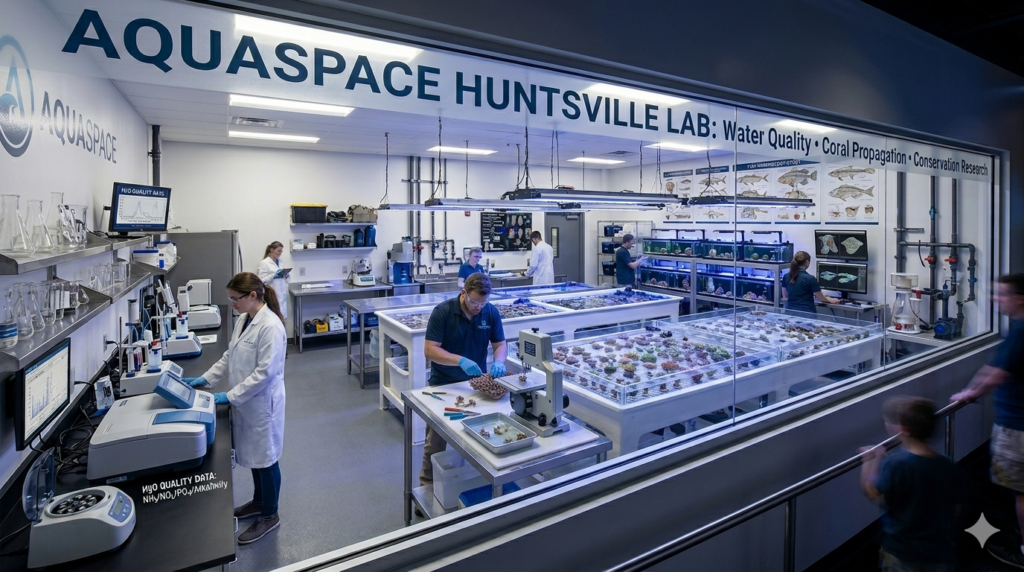
This facility is designed as a multi-functional hub that bridges high-level marine science with public education. The layout is strategically organized into four specialized “Zones,” creating an efficient workflow that is also completely visible to aquarium guests through the dedicated viewing windows.
Zone 1: The Water Quality & Analysis Suite
Visible immediately to guests on the left.
The Work: This is the analytical “engine room” of the aquarium. To maintain the health of thousands of marine animals, the water chemistry must be precise and stable.
- Spectrophotometer Station: This is the core piece of equipment in this suite. Your researchers will use it to perform incredibly precise measurements of trace elements, nutrients (like phosphates and nitrates), and potential pollutants. By analyzing how different wavelengths of light pass through a water sample, you can detect chemical concentrations at parts-per-million (PPM) or even parts-per-billion (PPB) levels.
- Benchtop Water Testing: Surrounding the spectrophotometer are specialized probes and titration setups for daily monitoring of essential parameters, including Salinity, pH, Alkalinity, Calcium, and Magnesium. This is a high-volume, continuous operation.
Why it matters: This data allows for preemptive adjustments to Life Support Systems (LSS). For guests, this station is a powerful exhibit demonstrating the complexity and critical importance of marine chemistry.
Zone 2: Coral Growth & Propagation Center
The large, prominent blue tanks in the center-right of the Lab.
The Work: This zone is dedicated to the sustainable cultivation of live corals. It serves as both a production farm and a research site for coral conservation.
- Multi-Level Coral Growth Tables: The complex, interconnected system of shallow tanks utilizes advanced, high-intensity LED lighting to maximize photosynthesis. Corals are grown here on specialized plugs, organized by species and fragment date.
- The Coral Fragging Table: This is where the work becomes precise and intricate. As seen in the diagram, a skilled staff member uses precision tools (diamond-bladed saws and bone cutters) to “frag” (fragment) a parent colony. Each new small fragment is a genetic clone that will grow into a new, independent colony.
Why it matters: These grown corals populate the aquarium’s main reef displays, completely eliminating the need to collect coral from the wild. Excess corals can be used for reef restoration research (conservation) or trade with other zoological facilities.
Zone 3: Fish & Invertebrate Research
The rear-right corner, backed by detailed anatomical charts.
The Work: This station focuses on biological research, specialized care, and morphological studies of marine animals.
- Fish Morphology Study: This chart indicates dedicated research into the physical form, structure, and adaptations of different fish species. Your team will analyze how different body shapes (morphology) correlate to specialized ecological niches.
- Research & Conservation Tanks: The specialized rack of isolated tanks allows for detailed observation of specific animals. This is critical for study protocols, behavioral research, and developing conservation strategies for threatened species.
- Digital Data Integration: The dedicated monitor/workstation allows researchers to integrate their biological observations (like micro-CT data) directly into digital models, aligning with your goals to build a morphological library.
Why it matters: This research generates new scientific knowledge, which directly informs conservation efforts. For example, understanding a species’ morphology can reveal vulnerabilities to environmental changes like ocean acidification.