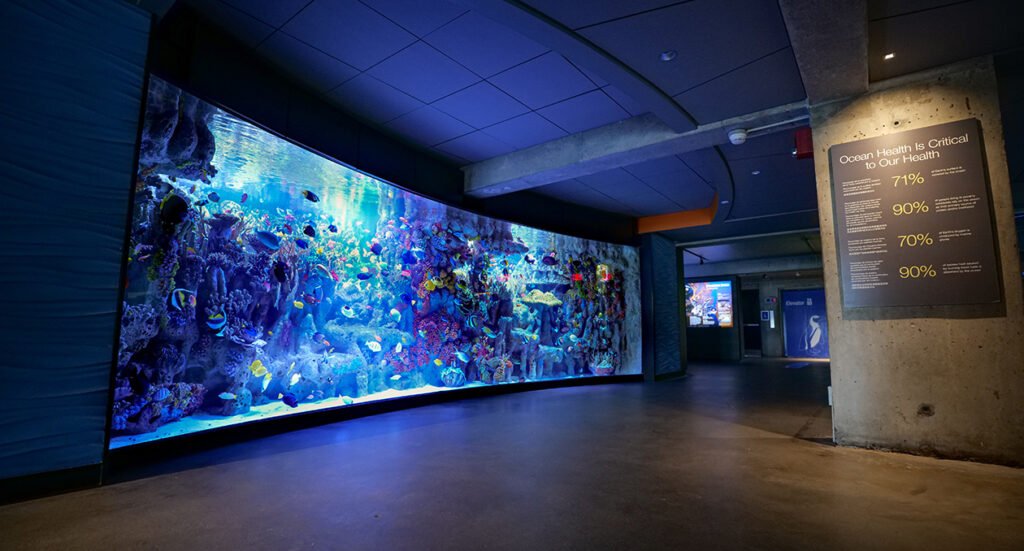
(similar but smaller in size to proposed tank)
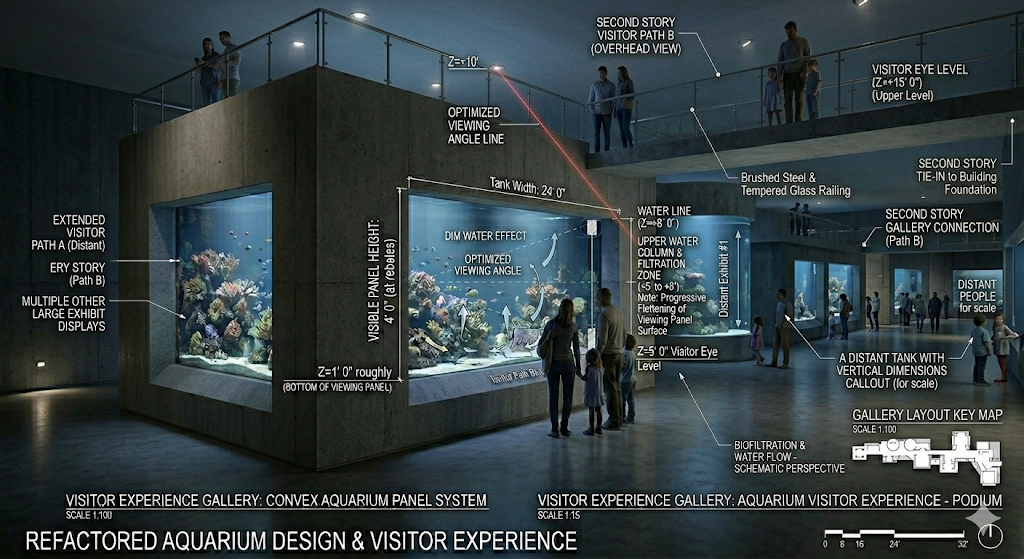
Indo Pacific Reef aquarium made of concrete with an overall width of 32′ feet long by 24′ wide by 9′ deep with 2 viewing panels supported on all sides, the first viewing panel being a 16ft wide x 4ft tall viewing window and another on the wide side that is 8ft. x 4ft. that gives creative sight lines so that one cannot see the other window from either viewpoint.
Designing a concrete aquarium with the specified dimensions and viewing panels requires careful consideration of structural integrity, water pressure, material properties, and aesthetic sight lines. Below is a detailed design outline for your 32′ long x 24′ wide x 9′ deep concrete aquarium with two acrylic viewing panels: one 16′ wide x 4′ tall and another 8′ wide x 4′ tall. The design includes:
structural specifications
viewing panel integration
+ suggestions for creative sight lines, while ensuring functionality and safety.
Aquarium Design Specifications
1. Overall Dimensions
- External Dimensions: 32′ (length) x 24′ (width) x 9′ (height, including freeboard).
- Internal Water Volume:
- Assuming a concrete wall thickness of 12″ (1 ft) on all sides and the base, the internal dimensions are:
- Length: 32′ – 2′ (two 1′ walls) = 30′.
- Width: 24′ – 2′ (two 1′ walls) = 22′.
- Water height: 9′
- Water Volume:
- 30′ x 22′ x 8′ = 5,280 cubic feet.
- 1 cubic foot = 7.48 gallons, so 5,280 x 7.48 ≈ 39,494 gallons.
- Assuming a concrete wall thickness of 12″ (1 ft) on all sides and the base, the internal dimensions are:
2. Material Specifications
- Concrete:
- Type: High-strength, reinforced concrete with a compressive strength of at least 5,000 psi to withstand water pressure and ensure durability in a wet environment.
- Reinforcement: #6 rebar (3/4″ diameter) in a grid pattern, spaced 12″ on center in both directions, embedded in walls and base to handle tensile forces.
- Thickness: 12″ for walls and base to resist hydrostatic pressure (calculated below) and provide structural stability.
- Sealing: Interior lined with a non-toxic, waterproof epoxy coating (e.g., polyaspartic or polyurethane-based) to prevent water seepage and ensure biocompatibility with aquatic life.
- Viewing Panels:
- Material: Cast acrylic, chosen for its clarity, strength, and resistance to water pressure.
- Panel 1: 16′ wide x 4′ tall x ~3.5″ thick (exact thickness calculated below).
- Panel 2: 8′ wide x 4′ tall x ~2.5″ thick.
- Mounting: Panels are supported on all sides by recessed concrete frames with silicone gaskets to ensure a watertight seal and distribute pressure evenly.
3. Structural Calculations
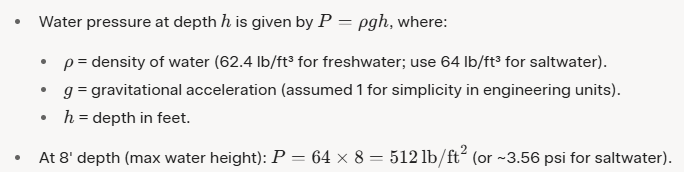
- Hydrostatic Pressure:
- Force on Viewing Panels:
- 16′ x 4′ Panel:
- Area = 16′ x 4′ = 64 ft².
- Average pressure (from 4′ to 8′ depth) ≈ 384 lb/ft² (midpoint pressure at 6′ depth).
- Total force = 64 x 384 ≈ 24,576 lbs.
- 8′ x 4′ Panel:
- Area = 8′ x 4′ = 32 ft².
- Total force = 32 x 384 ≈ 12,288 lbs.
- Acrylic Thickness:
- Using standard acrylic design charts (e.g., based on ASME PVHO-1 standards for pressure vessels for human occupancy, adapted for aquariums):
- For 16′ x 4′ panel at 8′ depth: ~3.5″ thick acrylic (safety factor of 5 for continuous loading).
- For 8′ x 4′ panel: ~2.5″ thick acrylic.
- These thicknesses ensure deflection remains within safe limits (<0.5% of panel width) and prevent cracking under long-term load.
- Using standard acrylic design charts (e.g., based on ASME PVHO-1 standards for pressure vessels for human occupancy, adapted for aquariums):
- 16′ x 4′ Panel:
- Concrete Wall Design:
- Maximum pressure at base (8′ depth) = 512 lb/ft².
- Wall thickness of 12″ with rebar reinforcement is sufficient to resist bending and shear stresses (based on ACI 318 standards for concrete design).
- Base slab: 12″ thick with double rebar mat to handle uplift and soil pressure (assuming proper soil compaction and a geotechnical report).
4. Viewing Panel Placement and Sight Lines
- Panel Locations:
- 16′ x 4′ Panel: Placed on one of the 32′ long sides, centered horizontally (8′ from each end) and vertically positioned with the top edge at 5′ above the aquarium floor (1′ below waterline, 4′ above floor). This allows viewers to see mid-level aquatic life (e.g., fish, corals) clearly while maintaining structural support.
- 8′ x 4′ Panel: Placed on one of the 24′ wide sides, offset to one side (e.g., 4′ from one end, 12′ from the other) to create an asymmetrical, dynamic viewing experience. Top edge at 5′ above the floor, aligning with the larger panel for visual consistency.
- Creative Sight Lines:
- Diagonal Views: The offset 8′ panel on the 24′ side allows viewers to see through both panels at an angle, creating a corner-to-corner sight line that showcases the aquarium’s depth (e.g., from the 8′ panel to the far end of the 16′ panel). This enhances the perception of space and movement of aquatic life.
- Layered Viewing: Positioning both panels at 4’–5′ height focuses views on the mid-water column, ideal for observing swimming fish, while the concrete above and below frames the view like a natural window.
- Lighting Integration: LED lighting (cool white, 5000K) installed along the top interior edge of the aquarium, angled to illuminate the water column without causing glare on the acrylic panels. This enhances visibility through both panels, creating vibrant sight lines.
- Aquascaping: Incorporate rockwork or artificial corals in a triangular layout, with the apex near the intersection of the two panels’ sight lines (e.g., near the corner where the 8′ panel meets the 32′ wall). This draws the eye through the aquarium, enhancing depth perception.
5. Additional Features
- Filtration and Life Support:
- Sump System: Large protein skimmers, mechanical filtration (rapid sand), and ozone injection tower.
- Circulation: Multiple water pumps (e.g., 4 x 10,000 GPH pumps) to achieve 5–10x tank turnover per hour for adequate water movement.
- Intakes: Central overflow weir along the back 32′ wall (opposite the 16′ panel) to minimize visual obstruction while maintaining water quality. three floor drains in strategic locations.
- Access and Maintenance:
- Top access catwalks and ladder into tank for feeding, maintenance, and equipment installation.
- Reinforced concrete walkway (4′ wide) at the top perimeter for safe public viewing.
- Aesthetics:
- Exterior concrete can be clad with vertical rockwork and corals.
- Interior epoxy coating in black or dark blue to reduce algae growth and enhance water color visibility.
- Reef: rockwork designed to hide filtration and host places for artificial coral, fans, sponges, etc.
6. Construction Considerations
- Foundation: Poured concrete foundation with proper rebar and compaction to support the aquarium’s weight (~400,000 lbs with water, assuming 10 lb/gallon for water, equipment, and concrete).
- Panel Installation:
- Acrylic panels are installed into recessed concrete frames with a 4″ lip on all sides for support.
- Silicone gaskets (1/2″ thick)
- Curing and Testing:
- Concrete curing time: 28 days to reach full strength.
- Fill test: Gradually fill the aquarium over 48 hours to monitor for leaks and structural integrity.
- Permits and Standards: Consult local building codes and an aquarium engineer to ensure compliance with structural and safety regulations (e.g., IBC for concrete structures, ASME PVHO-1 for acrylic panels).
7. Cost Estimate (Rough)
- Concrete: ~$150/yd³, ~200 yd³ required (walls, base, lid) = ~$30,000.
- Acrylic Panels: ~$100/ft², (64 ft² + 32 ft²) = 96 ft² x $100 = ~$9,600.
- Rebar and Reinforcement: ~$5,000.
- Filtration and Pumps: ~$10,000–$15,000.
- Labor and Installation: ~$50,000 (varies by region).
- Total: ~$100,000–$150,000 (excluding aquascaping, livestock, and exterior finishes).
- Note: For precise costs, consult a local contractor.
8. Visual Representation
Since you didn’t explicitly request a chart or diagram, I’ll describe a potential layout for clarity:
- Imagine a rectangular tank viewed from above:
- Long side (32′): 16′ x 4′ panel centered, spanning 8’–24′ along the length, 4’–8′ height.
- Short side (24′): 8′ x 4′ panel offset, spanning 4’–12′ along the width, 4’–8′ height.
- Sight Line: Standing at the 8′ panel’s left edge, you see diagonally across to the far right of the 16′ panel, creating a ~35′ diagonal view through the tank’s interior.
Creative Sight Line Enhancements
- Asymmetrical Aquascaping: Place a large rock or coral structure near the corner where the 8′ panel meets the 32′ wall, sloping downward toward the center. This guides the viewer’s eye along the diagonal sight line.
- Background Elements: Use a 3D background (epoxy-molded to look like a reef) on the non-windowed walls to add depth without obstructing views.
- Fish Selection: Stock with schooling fish (e.g., chromis, anthias, batfish) to create dynamic movement visible through both panels, enhancing the sense of a living ecosystem.
- Lighting Effects: Programmable LEDs with dimming to simulate day/night cycles, highlighting different tank areas to draw attention through the sight lines.
Recommendations and Next Steps
- Consult a Structural Engineer: Verify concrete and acrylic specifications for your specific water type (freshwater or saltwater) and local seismic conditions.
- Maintenance Plan: Budget for ongoing costs (~$5,000/year for electricity, water treatment, and livestock care).
This design balances structural integrity, functionality, and creative sight lines to create an impressive, large-scale aquarium. Let me know if you need further details, adjustments, or a visual representation!
Visual Representation 1: Top-Down View
This chart shows the aquarium’s footprint (32′ x 24′), the placement of the two viewing panels, and the diagonal sight line for creative viewing.
Explanation:
Updated Aquarium Design Specifications
1. Overall Dimensions and Modifications
- External Dimensions: Unchanged at 32′ (length) x 24′ (width) x 9′ (height, including freeboard).
- Internal Water Volume:
- Concrete wall thickness: 12″ (1 ft) on all sides and base.
- Internal dimensions: 30′ x 22′ x 8′ water depth (1′ freeboard).
- Volume: 30′ x 22′ x 8′ = 5,280 cubic feet ≈ 39,494 gallons (using 7.48 gallons/ft³).
- Raised Public Viewing Floor:
- Public floor elevated 3′ above the tank’s base (ground level).
- Viewing panels now start at 4′ from the tank’s bottom (1′ above the public floor) and extend to 8′ (1′ below water surface), making them 4′ tall.
- Second-Story Public Viewing Area:
- Located at the top of the aquarium (9′ height), accessible via stairs or an elevator.
- Positioned on the 32′ side opposite the 16′ panel, with a viewing platform overlooking the open water surface.
- Maintenance catwalks (4′ wide) on the remaining top perimeter for staff access, separated from the public area.
2. Viewing Panel Adjustments
- Panel Specifications:
- 16′ x 4′ Panel: On one 32′ side, centered (8′ to 24′), vertically positioned from 4′ to 8′ above the tank’s bottom (1′ to 5′ above the public floor).
- 8′ x 4′ Panel: On one 24′ side, offset (4′ to 12′ along the width), also from 4′ to 8′ above the tank’s bottom.
- Acrylic Thickness:
- At 8′ max depth, hydrostatic pressure ≈ 512 lb/ft² (saltwater, 64 lb/ft³).
- 16′ x 4′ panel: ~3.5″ thick (per ASME PVHO-1 standards, safety factor of 5).
- 8′ x 4′ panel: ~2.5″ thick.
- Mounting: Supported on all sides by 12″ concrete frames with 2″ lips, sealed with silicone gaskets.
- Viewer Experience:
- Public floor at 3′ means the panel bottom is at 1′ above the floor, ideal for eye-level viewing (assuming average eye height of ~5′ for adults, ~3′ for children).
- Top of panels at 8′ (5′ above public floor) aligns with the 8′ waterline, maximizing visibility of the mid-to-upper water column.
3. Second-Story Viewing Area and Maintenance Catwalks
- Second-Story Viewing Platform:
- Location: Along the 32′ side opposite the 16′ panel (y=24 in top-down view).
- Size: 32′ long x 6′ wide x 1′ thick (reinforced concrete or steel platform).
- Height: At 9′ (tank top), with a 3′ high safety railing (glass or stainless steel) for unobstructed top-down views into the 8′ deep water.
- Access: External stairs or elevator (not detailed here; consult an architect for ADA compliance).
- Features: Non-slip surface, LED lighting (5000K) for nighttime viewing, and optional interpretive signage for aquatic life.
- Maintenance Catwalks:
- Location: Along the remaining three sides (one 32′ side and two 24′ sides).
- Size: 4′ wide, reinforced concrete or steel, with 3′ safety railings.
- Features: Access hatches (2′ x 2′) every 8′ for maintenance (feeding, cleaning, equipment checks).
- Separation: Physical barriers (e.g., locked gates) ensure public cannot access catwalks.
- Structural Support:
- Platform and catwalks supported by steel beams anchored to the concrete walls, designed to handle 100 psf live load (per IBC for public assembly).
- Additional concrete columns (12″ x 12″) at corners if needed, based on a structural engineer’s analysis.
4. Structural and Hydrostatic Considerations
- Concrete: 12″ thick, 5,000 psi, reinforced with #6 rebar (12″ on center). Epoxy-coated interior for waterproofing and biocompatibility.
- Hydrostatic Pressure: Unchanged (512 lb/ft² at 8′ depth). Panel thickness and concrete walls remain adequate.
- Raised Floor:
- 3′ high concrete or steel platform, supported by columns or walls (12″ thick) below the tank.
- Weight: Tank (~400,000 lbs with water) requires a robust foundation; raised floor adds ~10,000 lbs (assuming 6″ concrete slab, 32′ x 24′).
- Top Platform:
- Second-story platform and catwalks add ~5,000–10,000 lbs, requiring additional beams or brackets.
- Consult a structural engineer to verify load distribution and foundation capacity.
5. Creative Sight Lines
- Ground-Level Sight Lines:
- Diagonal view from the 8′ panel’s left edge (x=0, y=4) to the 16′ panel’s right edge (x=24, y=0) remains (~35′ diagonal).
- Panels at 1’–5′ above the public floor ensure accessibility for all ages, focusing on mid-water column (fish, corals).
- Aquascaping: Triangular rock structure near the corner of the 8′ panel and 32′ wall to guide the eye.
- Second-Story Sight Lines:
- Top-down view into the 8′ deep water column, showcasing surface-dwelling fish and aquascaping from above.
- Lighting: Angled LEDs (5000K) along the tank’s interior top edge enhance visibility without glare on the water surface.
- Optional: Submerged features (e.g., tall corals or driftwood) extend toward the surface to create visual interest for top-down viewers.
6. Visual Representations
Below are visualizations for the top-down and side views, reflecting the raised public floor, adjusted panel heights, and second-story viewing area.
Visual Representation 1: Top-Down View
This chart shows the aquarium’s footprint, panel placements, diagonal sight line, and the second-story viewing platform with maintenance catwalks.
- Aquarium Outline: 32′ x 24′ internal dimensions.
- 16′ x 4′ Panel: On the bottom 32′ side (y=0, x=8 to x=24).
- 8′ x 4′ Panel: On the left 24′ side (x=0, y=4 to y=12).
- Sight Line: Diagonal from (0,4) to (24,0).
- Second-Story Platform: Along y=24 (32′ x 6′).
- Catwalks: Along y=0 (outside 16′ panel), x=0 (outside 8′ panel), and x=32.
- Aquascaping: Triangular rock structure near (2,2).
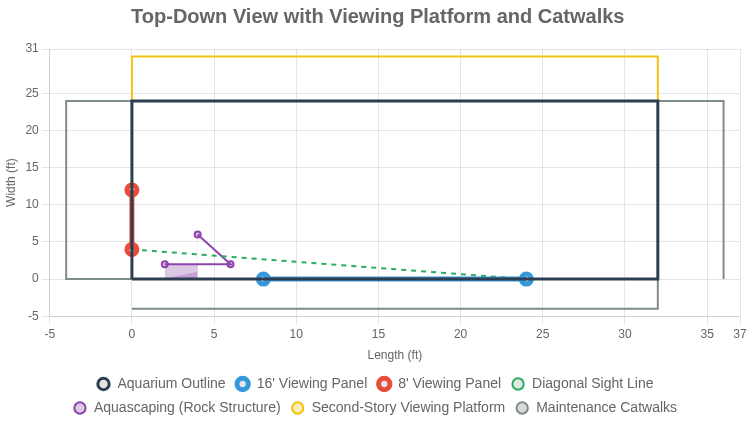
Explanation:
- Blue line: 16′ panel on y=0.
- Red line: 8′ panel on x=0.
- Green dashed line: Diagonal sight line.
- Purple triangle: Aquascaping near (2,2).
- Yellow rectangle: Second-story viewing platform (y=24 to y=30).
- Gray lines: Catwalks along y=0, x=0, and x=32 (extended slightly for visibility).
- The chart shows how the public platform and catwalks surround the tank without overlapping.
Visual Representation 2: Side View (32′ Side with 16′ Panel)
This chart shows the vertical profile, including the raised public floor, adjusted panel height, and second-story platform.
Description:
- Aquarium Wall: 32′ x 9′.
- 16′ x 4′ Panel: From 4′ to 8′ above the tank’s bottom.
- Public Floor: At 3′ above the tank’s base.
- Water Level: At 8′.
- Second-Story Platform: At 9′, along the opposite 32′ side.
- Eye Levels: Ground-level (~5′ above public floor, 8′ above tank bottom) and top-level (~5′ above platform, 14′ above tank bottom).
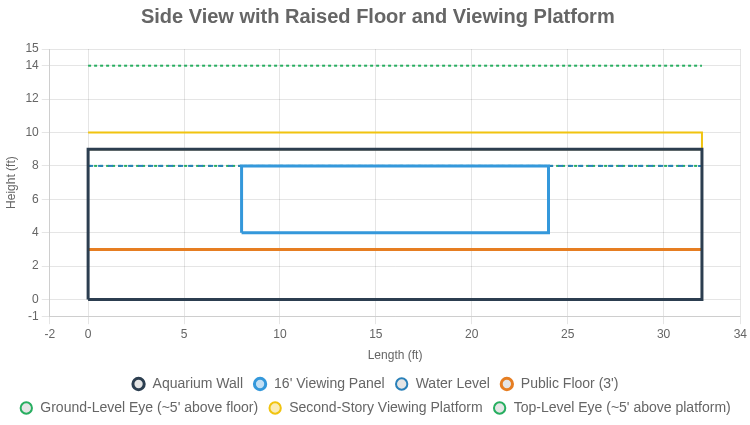
Explanation:
- Blue rectangle: 16′ panel (4’–8′ height).
- Orange line: Public floor at 3′.
- Dark blue dashed line: Water level at 8′.
- Yellow rectangle: Second-story platform at 9’–10′.
- Green dashed lines: Eye levels (8′ for ground, 14′ for top).
- The chart shows how the raised floor positions the panel at 1’–5′ above the public, ideal for viewing, and the top platform offers a top-down perspective.